1

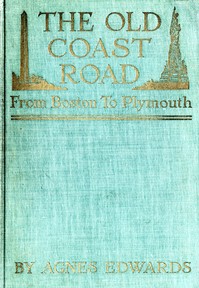
The Old Coast Road From Boston to Plymouth — Key Ideas to Explore
6
1
Project Gutenberg
2007
South Shore (Mass. : Coast); Plymouth County (Mass.) -- Description and travel; Norfolk County (Mass.) -- Description and travel
Readers of public-domain and historical texts
Project Gutenberg digital edition
en
Edition facts
Words: 41,858
Reading time: 182 min
Text sections: 5
Source:
Project Gutenberg record #21895
Agnes Rothery's 1920 travelogue traces the Old Coast Road from Boston to Plymouth, blending local history, architecture, and coastal geography with a wry affection for New England's idiosyncrasies.
Editorial Edition Score
4.7/5
★★★★★
★★★★★
Calculated from edition completeness, EPUB availability, text structure and catalogue metadata. Not a user rating.
Edition quality
Agnes Rothery opens her 1920 travelogue with a wry confession: "To love Boston or to laugh at Boston—it all depends on whether or not you are a Bostonian." This double-edged affection sets the tone for a journey that is as much about cultural character as about landscape. The Old Coast Road, running from Boston to Plymouth, becomes a thread stitching together shipyards, salt marshes, and colonial meetinghouses. Rothery’s eye for detail—the precise cutting of Quincy granite for Minot’s Light, the “business of wrecking” in Cohasset—turns a simple route into a layered narrative of industry, disaster, and resilience.
A Foreword’s Ambivalence
Rothery’s foreword immediately establishes a tension between pride and parody. She catalogs Boston’s rituals—"baked beans on Saturday night and fish balls on Sunday morning," the "Boston bag," the "Bostonese pronunciation"—with a mixture of amusement and affection. This is not boosterism but a knowing wink. The metaphor of cutting "through the various layers of a fruity layer cake" suggests that history, like geography, is stratified. The foreword frames the entire book as a cross-section, where every locality reveals a slice of time. Rothery does not shy from admitting that old cities become "tenacious of their idiosyncrasies," and her own voice mirrors that tenacity: she is both insider and observer, gently mocking what she cherishes.
Cohasset: Ledges, Wrecks, and Engineering
The Cohasset chapter exemplifies Rothery’s method: she moves from a 1614 encounter with Captain John Smith to the salvage of a Spanish frigate off Venezuela, then to the construction of Minot’s Light. The transitions are swift, held together by the physical fact of the ledges. Smith’s own words are quoted—"We found the people on those parts very kind, but in their fury no less valiant"—and Rothery adds that "history follows fast along the ledges." She details the "clumsy diving-bell method" used by Captain Tower and his crew, who recovered fourteen thousand dollars in silver coin. The lighthouse itself is described with almost biblical reverence: "the stone was selected with the utmost care," and the old base on Government Island remains "as smooth as a billiard table." Rothery’s prose here is precise, almost technical, yet never dry; she conveys the romance of salvage and the audacity of building on a ledge "awash at high tide."
The Road as a Narrative Spine
Rothery structures her book as a sequence of towns—Dorchester, Milton, Quincy, Weymouth, Hingham, Cohasset, Scituate, Marshfield, Duxbury, Kingston, Plymouth—each with its own character. The road itself is rarely described; instead, it serves as a pretext for digressions into shipbuilding, ecclesiastical history, and domestic architecture. The illustrations by Louis H. Ruyl (listed in the contents) suggest a visual complement to Rothery’s verbal sketches. Her method is associative: a mention of Daniel Webster leads to Marshfield, a mention of the Standish Monument leads to Kingston. The reader is invited to follow not a strict itinerary but a web of connections. Rothery’s voice remains constant—urbane, slightly ironic, deeply curious—and the road becomes a device for holding together disparate stories of New England’s coastal past.
Rothery’s book rewards readers who enjoy local history told with personality rather than pedantry. The chapters can be read in any order, each offering a self-contained portrait. Pay attention to the recurring tension between natural hazard and human ingenuity—the ledges that wreck ships and the engineering that tames them. The foreword’s ambivalence toward Boston echoes throughout: these are towns shaped by both pride and peril.
Reader reflection
Record your reading impressions
A brief reflection can help important ideas stay with you longer.
Your progress
0
/
10
2
Did this book hold your interest?
3
Would you encourage someone else to read it?
4
What was the reading difficulty like?
5
Did the book give you something worth debating?
6
Did the book deliver what you hoped for?
7
How much did the book move you?
8
How closely did the book connect with your experience?
9
What did this book teach you most?
10