1

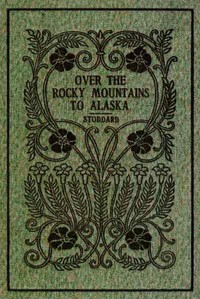
Over the Rocky Mountains to Alaska — Text and Context
8
3
Project Gutenberg
2007
West (U.S.) -- Description and travel; Alaska -- Description and travel
Readers of public-domain and historical texts
Project Gutenberg digital edition
en
Edition facts
Words: 35,609
Reading time: 155 min
Text sections: 4
Source:
Project Gutenberg record #22871
Stoddard's 1899 travelogue from Notre Dame to Alaska blends romantic nostalgia with precise observations of fog navigation, totem-pole hunting, and the eerie stillness of the Inside Passage, revealing a tension between civilized sentiment and raw frontier.
Editorial Edition Score
4.5/5
★★★★★
★★★★★
Calculated from edition completeness, EPUB availability, text structure and catalogue metadata. Not a user rating.
Edition quality
Stoddard opens not on a train platform but in the midst of Notre Dame's commencement week, a scene of 'boyish delights' and 'bevies of beautiful girls' that he renders with theatrical relish. The transition from this sheltered elysium to the 'region of desolation' of Alaska is abrupt and deliberate. Throughout the excerpts, he oscillates between painterly description—'the fog-banks went to pieces and rolled away in sections out of sight, like the transformation scene in a Christmas pantomime'—and a more anxious attention to practical dangers: sounding for depth, listening for echoes, backing out of wrong channels. This tension between aesthetic pleasure and survival instinct gives the narrative its distinctive pulse.
Echoes and Ice: Navigating by Sound
In the fog-bound Alaskan archipelago, Stoddard's party relies on a surprisingly primitive technique: they blow a whistle and measure the returning echo. 'Sometimes it returned to us almost on the instant and we cried, "Halt!"' he writes, turning the ship into a giant echolocation device. The method is both practical and poetic—'the horns of elf-land' whisper reassurance of sea-room. This scene encapsulates a recurring pattern: the traveler must read the landscape through indirect cues, whether sound, color of water, or the 'ghastly hue' that chills the marrow. Stoddard notes that the water takes on a warning tint before the ice fields appear, and that vegetation 'dying out' signals the approach of glaciers. The narrative voice is that of a man schooling his senses, learning to 'detect the most delicate shades of sound' and to weigh each echo with 'utmost self-satisfaction.'
The Monotony of Beauty
Stoddard admits a surprising fatigue: 'Hour after hour and day after day we are coasting along shores that become monotonous in their beauty.' The phrase undercuts the expected sublime. He notes the 'sea-washed roots of the forest' forming an impassable barrier, and the rare human habitations that 'can scarcely be said to enliven' the scene, comparing Indian lodges to 'a last year's bird's-nest.' This is not the language of a wide-eyed tourist but of a traveler worn down by repetition. Yet the monotony is itself a kind of evidence—of the sheer scale of the coast, the sparseness of settlement, the difficulty of making landfall. When he does find a village, it offers only a 'hope of a break in the serenity,' a phrase that turns serenity into a burden. The search for a totem-pole becomes a quest for meaning in a landscape that resists narrative climax.
Civilized Sentiment in a Raw Land
The opening chapters at Notre Dame are drenched in sentimental ritual: the 'wreath of stars' on the golden statue, the 'stream of Saratogas' thundering to the station, the 'blaze of glory' of commencement. Stoddard brings this same emotional vocabulary to Alaska, describing a little islet as 'worthy to be made the head-piece or tail-piece to some poem on solitude.' He anthropomorphizes the island as 'crouching there, lying in wait for us, ready to arch its back.' The collision between his ornate, late-Victorian prose and the stark Alaskan setting produces a strange friction. He calls the Indians 'children of Nature' whose song-birds are 'the screaming eagle, the croaking raven'—a romantic primitivism that sits uneasily beside his precise observations of their paddling technique. The reader watches a cultivated sensibility trying to domesticate the wild through language, and partly failing.
The Booming Glaciers
As the journey nears the ice, Stoddard's prose shifts from picturesque to ominous. He writes of being 'nearly within sound of the booming glaciers' and broods over 'the oft imagined picture of that vast territory—our Alaska,—where, beyond that mountain range, the almost interminable winter is scarcely habitable, and the summers so brief it takes about six of them to make a swallow.' The hyperbole is deliberate: six summers to make a swallow is a folk exaggeration that conveys the compression of life in the North. The glaciers themselves are never described directly in these excerpts—they remain a sound, a threat, a limit. This withholding is effective. Stoddard lets the reader feel the approach without granting the payoff of a full view, maintaining the tension between anticipation and arrival that structures the whole narrative.
Stoddard's account rewards readers who attend to the interplay between his ornate sensibility and the uncooperative landscape. He is not a dispassionate observer; he is a man carrying the emotional weight of a Notre Dame commencement into the fog of the Inside Passage. The echoes he measures, the totem-poles he seeks, the glaciers he hears but does not yet see—all are refracted through a consciousness that expects beauty and finds it, but also finds monotony, danger, and a kind of desolation that resists his literary framing. Read for the moments when the prose cracks, when the romantic veil lifts to reveal the chill underneath.
Reader reflection
Before you leave, reflect on the book
Use these questions to collect your thoughts before moving on.
Your progress
0
/
10
2
How much did you enjoy the reading experience?
3
How likely are you to recommend this book?
4
Did the language feel accessible?
5
How useful were the ideas in this book?
6
How would you rate its originality?
7
Did any part of the book feel personally relevant?
8
Did the story or argument move comfortably?
9
What changed or sharpened your thinking?
10