1

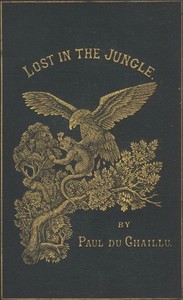
Lost in the Jungle; Narrated for Young People — Edition Insights
31
9
Project Gutenberg
2011
Africa, West -- Description and travel; Africa, West -- Description and travel -- Juvenile literature
Readers of public-domain and historical texts
Project Gutenberg digital edition
en
Edition facts
Words: 72,229
Reading time: 315 min
Text sections: 9
Source:
Project Gutenberg record #36324
Paul Du Chaillu's firsthand narrative of equatorial African exploration, detailing encounters with gorillas, leopards, and local customs, framed for young readers through vivid, often tense episodes.
Paul Du Chaillu's Lost in the Jungle opens with a direct address to young readers, promising a narrative of being 'lost in the jungle' that is both literal and figurative. The author, a seasoned explorer, immediately establishes a tone of intimate adventure, recounting episodes such as harpooning a manga, capturing a young eagle, and confronting gorillas. The text is punctuated by precise observations of animal behavior, local customs, and the physical challenges of the environment. Du Chaillu's voice is that of a guide who shares both the thrill and the peril of his journeys, often noting the reactions of his African companions and the intricate social structures of the villages he visits.
A Narrative of Close Encounters
The excerpts reveal a pattern of intense, close-range encounters with wildlife. Du Chaillu describes shooting a leopard, fighting gorillas, and capturing a young gorilla named Jack, who tears his pantaloons and refuses cooked food. These episodes are rendered with specific, sometimes humorous detail: Jack 'sleeps with one eye open' and is 'intractable.' The author's focus on the animals' physicality and behavior—such as the gorilla's 'immense hands and feet'—grounds the narrative in tangible observation rather than generalization. The reader is placed in the midst of action, from the 'fearful roars of gorillas' to the 'great flight of crabs' that bite hard.
Customs and the Supernatural
Du Chaillu frequently documents the beliefs and rituals of the people he encounters. In one passage, he is led to a 'dwarfish house' containing three human skulls—those of a father, uncle, and brother—along with fetiches adorned with eagle claws and ant-eater scales. The scene is described with a matter-of-fact tone that underscores the cultural distance: 'Oyagui never spoke a word.' The author also notes the silence of a village during a new moon, when men painted their bodies and refrained from dancing. These details, presented without overt judgment, offer a window into the spiritual and social frameworks that shape the explorer's interactions.
The Explorer's Dual Perspective
A recurring tension in the text is Du Chaillu's simultaneous weariness and compulsion to continue. After a period of 'hard and exciting life,' he decides to return toward the coast, only to find himself drawn back into the jungle. At Washington, his village near the sea, he describes the 'booming sound' of the surf as 'like music' and contrasts the open Atlantic with the 'everlasting jungle.' Yet he acknowledges that 'the time had not yet come' to return home; he must discover 'new mountains, new rivers, new tribes.' This push-pull between the comforts of civilization and the call of the unknown is a defining feature of the narrative, reflecting the author's identity as both a scientific collector and a restless adventurer.
The Role of Local Knowledge
Du Chaillu frequently relies on the expertise of his African companions, such as Querlaouen, Malaouen, and Gambo. Their knowledge of the terrain, animal behavior, and local customs is integral to his survival and success. For instance, when Querlaouen declares they are 'bewitched,' it is not dismissed but recorded as part of the cultural landscape. The author also notes that the Commi people made him a makaga, a title reserved for the best hunter and bravest man, indicating a reciprocal relationship of respect. These details highlight the collaborative nature of exploration, countering any notion of the lone European hero.
Readers approaching Lost in the Jungle should attend to the interplay between Du Chaillu's scientific aspirations and his narrative instincts. The book is neither a dry travelogue nor a mere adventure story; it is a record of specific, often unsettling encounters that resist easy categorization. Pay attention to the moments of stillness—the silent village, the lone observer on the shore—as much as the dramatic hunts. These pauses reveal the author's reflective side and deepen the portrait of a man caught between two worlds.
Reader reflection
Take a moment to reflect on this book
Create a short personal record of your experience with this book.
Your progress
0
/
10
2
How did the book work for you overall?
3
Would you recommend this book to another reader?
4
How easy was the book to follow?
5
How clear did the writing feel?
6
How did the reading compare with what you expected?
7
Would you like to discuss this book with someone?
8
How strongly did the book affect you emotionally?
9
Which lesson or insight stayed with you?
10