1

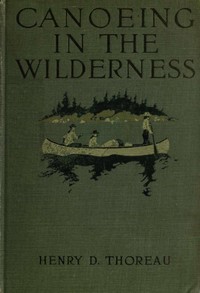
Canoeing in the wilderness — Inside the Classic
(0 User reviews)
732
Project Gutenberg
2011
Not confirmed
Canoes and canoeing; Maine -- Description and travel; Piscataquis County (Me.) -- Description and travel
Readers of public-domain and historical texts
Project Gutenberg digital edition
en
Edition facts
Words
37,187
Reading time
162 min
Text sections
13
Before opening Canoeing in the wilderness — Inside the Classic, the edition data offers a quick orientation: 37,187 words, 2 hr 42 min estimated reading time, and 13 detected text sections.
The text analysis averages about 24.5 words per sentence, while the detected sections provide another way to judge how the source is divided.
Project Gutenberg metadata also associates the work with “Canoes and canoeing,” connecting these edition facts with the source record’s subject description.
Source:
Project Gutenberg record #34990
Thoreau's account of an 1857 canoe trip through Maine's wilderness, blending precise natural observation with sharp critique of logging culture, as edited by Clifton Johnson with illustrations by Will Hammell.
Read the complete public-domain text at its original source.
Read on Project GutenbergThoreau's prose in Canoeing in the Wilderness moves between two distinct registers: the patient, cataloguing eye of a naturalist and the sardonic bite of a social critic. The excerpts show him noting the exact behavior of a sheldrake or the flight of a devil's-needle half a mile from shore, then pivoting to a blistering commentary on loggers who admire a pine only for the oxen that can stand on its stump. This editorial note examines how Thoreau's diction and descriptive choices shape the narrative of his 1857 Maine journey.
The Logger's Language and Thoreau's Counter-Voice
Thoreau renders the logger's admiration through a telling verbal tic: the logger measures a tree by what can be done to it. The phrase "so big that a yoke of oxen stood on its stump" becomes a refrain that Thoreau dissects with deliberate literalism. He imagines the oxen "chewing their cud" atop successive stumps, reducing the forest to an "ox-pasture." The humor is dry, but the critique is structural: the logger's praise is for the "carcass or corpse" of the tree, not the living thing. Thoreau's own diction counters this—he speaks of the tree's "spirit" and the "mythology" that retreats as the axe advances. The contrast is not just ideological but lexical: where the logger uses a language of utility and aftermath, Thoreau reaches for the animate and the symbolic.
The Indian Guide as a Figure of Measured Attention
Thoreau's treatment of his Penobscot guide, Joe Polis, is notable for what it includes and what it withholds. The excerpts show Thoreau recording the guide's practical knowledge—identifying Peaked Mountain as a lookout for timber, noting that blue herons nest in hard-wood trees, and immediately cutting a canoe birch for camp. Yet Thoreau also registers moments of cultural distance: the guide would have "gladly" killed and eaten a great gull, but the bird flies before they approach. Thoreau does not romanticize or sentimentalize; he presents the guide's actions and remarks with a plainness that respects their utility. The guide's "evening prayer" is mentioned in the illustration list, but the text itself keeps him at a slight remove, a figure observed rather than ventriloquized.
The Unruly Landscape and the Observer's Eye
Thoreau's descriptions of the Maine landscape resist the picturesque. Heron Lake appears "ragged and unsightly," its shores "encumbered with dead timber" from a downstream dam. The scene is not pristine wilderness but a managed, damaged space. Yet within this, Thoreau's eye finds precise details: the shadflies that "fly over the whole lake," the summer ducks flushed from a rock, the abandoned moose-hide frame on an island. His syntax often follows the sequence of perception—"Rounding a point, we stood across a bay"—placing the reader in the canoe's motion. The landscape is not a backdrop but a series of encounters, each noted with a naturalist's specificity and a traveler's fatigue.
The Editorial Frame: Clifton Johnson's Introduction
Editor Clifton Johnson's introduction, written for the 1916 edition, shapes how readers approach Thoreau's text. Johnson emphasizes Thoreau's "half wild" tastes and his impatience with "artificiality," framing the journey as a retreat from civilization. He also stresses Thoreau's accuracy as an observer, calling him "careful and accurate" and noting that his "fancy is so well balanced by his native common sense." This editorial voice—earnest, slightly defensive—positions Thoreau as both a literary figure and a reliable reporter. Johnson's choice to excerpt the latter half of The Maine Woods and to include Will Hammell's illustrations (such as "The Indian Guide's Evening Prayer") suggests an intent to package the narrative as a self-contained adventure, accessible to a general audience.
Readers attentive to Thoreau's word choices will find a text that is never merely descriptive. His habit of undercutting a scenic observation with a dry remark, or of juxtaposing the guide's practical knowledge with his own meditative bent, creates a layered account of the Maine woods. The journey is both a physical passage and a running argument about how to see—and what to value—in a landscape under pressure.
Reading Thoreau’s quiet notes on the Maine woods, I remembered sitting on my grandfather’s porch, tracing his old logbook’s faded ink. That same unhurried ache of time passing, of places changing beneath our feet, came back with South African Memories Social, Warlike & Sporting from Diaries Written at the Time — Story, Setting & Ideas, where a diary’s small, sharp details held a world already gone. Both made me feel like a visitor to someone else’s weather.
There are no reviews for this eBook.
There are no comments for this eBook.
Reader reflection
What was your reading experience?
Capture what you thought, learned, and would like to remember.
Your progress
0
/
10
2
How did the book work for you overall?
3
Is this a title you would suggest to others?
4
How demanding did the text feel?
5
How useful did the reading feel?
6
How clear did the writing feel?
7
How strong was your personal connection to the text?
8
What was the strongest part of the book?
9
Which lesson or insight stayed with you?
10