1

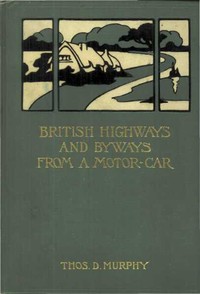
British Highways and Byways from a Motor Car Being a Record of a Five Thousand Mile Tour in England, Wales and Scotland — Background and Themes
7
1
Project Gutenberg
2005
Great Britain -- Maps; Great Britain -- Description and travel
Readers of public-domain and historical texts
Project Gutenberg digital edition
en
Edition facts
Words: 78,123
Reading time: 340 min
Text sections: 11
Source:
Project Gutenberg record #17297
A 1908 motor tour record covering 5,000 miles through England, Wales, and Scotland, focusing on rural byways, historic ruins, and local character rather than cities, with detailed observations of landscapes and architecture.
Editorial Edition Score
4.8/5
★★★★★
★★★★★
Calculated from edition completeness, EPUB availability, text structure and catalogue metadata. Not a user rating.
Edition quality
Thos. D. Murphy's 1908 account of a five-thousand-mile summer motor tour deliberately avoids the beaten paths of British touring, as he states in his foreword. The book is not a guidebook, but a chronicle of visits to out-of-the-way places, with commentary on highways, towns, and countryside. Murphy emphasizes that the journey was not of cities but of 'the most delightful country in the world, with its towns, villages, historic spots and solitary ruins.' The catalog subjects list 'Great Britain -- Maps' and 'Great Britain -- Description and travel,' yet the excerpts reveal a strong emphasis on historical narrative and personal reaction, particularly to sites of violence and suffering, such as Dunnottar Castle.
A Motorist's Selective Geography
The catalog subjects classify this work under 'Great Britain -- Maps' and 'Great Britain -- Description and travel,' but the text itself is far from a systematic geography. Murphy explicitly states he did not attempt a guidebook, and his route choices reflect personal priorities over comprehensive coverage. For example, he bypasses the scenic route through Braemar and Balmoral—'the route usually followed by British motorists'—because, as an American, he finds Scottish scenery merely 'an incident in a tour' compared to the Yellowstone and Yosemite. Instead, he takes a coast road 'thickly strewn with places replete with stirring and romantic incidents of Scottish history.' This selective approach means the book's geography is shaped by historical interest and the author's cultural perspective, not by an aim to map all of Britain.
The Weight of History at Dunnottar Castle
Murphy's description of Dunnottar Castle is the most detailed excerpted passage and reveals his narrative method. He does not simply note the castle's location and architecture; he dwells on its grim history, particularly the 'Whig's Vault' where 160 covenanters were confined. He describes the dungeon as 'ankle deep in mire' and notes that prisoners 'could not sit without leaning upon another.' The language is emotive: 'a rude, semi-barbarous age, an age of rapine, murder and ferocious cruelty.' This passage shows that Murphy's travel writing often becomes historical storytelling, using specific, gruesome details to evoke the past. The catalog subject 'Description and travel' understates the extent to which the book is a vehicle for historical anecdote and moral commentary.
Illustrations as Evidence
The foreword boasts of the book's illustrations: sixteen colour plates from watercolours by prominent artists (some exhibited at the Royal Academy) and thirty-two duogravures from photographs. Murphy claims 'there can be no question concerning the pictures.' The excerpt includes a caption for a colour plate of 'Old Half-Timbered Houses in Ledbury' and a duogravure of Dunnottar Castle. These images are integral to the book's design, not mere decoration. The catalog subjects do not mention illustrations, yet the visual record is a key component of the work's value as a period document. Readers should note that the text and images together create a layered portrait of early 20th-century British travel, where the author's written impressions are complemented by carefully selected artistic and photographic views.
Murphy's book is best approached as a personal narrative rather than a systematic travel guide. The excerpts show a writer who uses historical episodes to animate landscapes, and who measures British scenery against American benchmarks. Readers interested in Edwardian motoring culture, early tourism, or the reception of British history by American visitors will find specific, opinionated material here. The maps mentioned in the foreword are not excerpted, but the text's route descriptions and place names offer a practical itinerary for those who wish to follow Murphy's path.
Reader reflection
Your personal reading reflection
Build a private reading journal entry for this title.
Your progress
0
/
10
2
What was your overall reaction to the book?
3
Is this a title you would suggest to others?
4
How demanding did the text feel?
5
Is this a title worth rereading?
6
Would you start a conversation about this book?
7
How much did the book move you?
8
Did the book deliver what you hoped for?
9
What changed or sharpened your thinking?
10