1

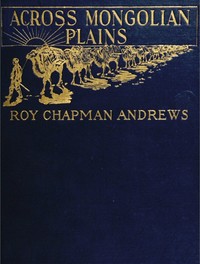
Across Mongolian Plains A Naturalist's Account of China's 'Great Northwest' — Text and Context
11
2
Project Gutenberg
2009
Mongolia -- Description and travel; Zoology -- Mongolia; Hunting -- Mongolia
Readers of public-domain and historical texts
Project Gutenberg digital edition
en
Edition facts
Words: 81,512
Reading time: 355 min
Text sections: 27
Source:
Project Gutenberg record #29024
Roy Chapman Andrews recounts his 1918-1919 Second Asiatic Expedition across Mongolia, blending natural history with travel narrative. The text reveals tensions between scientific collection and local customs, as seen in a near-miss at a forbidden temple and the comic spectacle of a motorcar stranded by a flash flood.
Editorial Edition Score
4.9/5
★★★★★
★★★★★
Calculated from edition completeness, EPUB availability, text structure and catalogue metadata. Not a user rating.
Edition quality
Roy Chapman Andrews opens his account of the Second Asiatic Expedition with a deliberate choice: he writes for the sportsman, not the specialist, and promises to withhold the scientific details that would weary a general reader. The preface frames Mongolia as a hunting ground valued not for the quantity of game but for its quality and scientific importance, a claim that sets the tone for a narrative constantly negotiating between the demands of field zoology and the unpredictability of travel.
The excerpts that survive from Across Mongolian Plains show a writer attentive to the absurd and the precarious. A motorcar marooned on an island by a rising torrent, the frantic flight of yaks losing all dignity, and a forbidden temple entered on impulse all appear within a few pages, suggesting a book that moves between scientific purpose and the accidents of the road.
The Naturalist as Unwilling Philosopher
Andrews repeatedly contrasts his own impatience with what he calls the “philosophical nature of the Oriental.” Camped within rifle shot of Urga, he confesses it was “a sore trial” not to enter the city, but he dared not leave specimen-laden carts to servants and curious Mongols. The remark is revealing: the expedition’s scientific mission is constantly shadowed by a need for security and a frustration with delay. Andrews does not elaborate on what he means by “philosophical,” but the phrase suggests a cultural shorthand that recurs in travel writing of the period. Readers may note how often the narrator’s own restlessness shapes the pace of the narrative, and how local practices—whether religious restrictions or the rhythms of caravan travel—are measured against that restlessness.
Temples, Cameras, and Close Calls
Two episodes in the excerpts hinge on the tension between observation and transgression. In the first, Andrews and his wife slip through the gates of a temple in Urga, knowing women are forbidden inside. They are discovered only by the stir of lamas and flee “like frightened rabbits”; later they learn that discovery could have provoked a mob. In the second, Andrews films the same temple from a cart on a subsequent day, only to have a crowd gather and the situation turn volatile. The camera, like the naturalist’s collecting, is an instrument of scrutiny that can provoke hostility. The excerpts do not reveal the outcome of either incident, but the pattern is clear: the expedition’s work depends on a fragile permission that can be revoked at any moment.
Water, Weather, and the Unruly Landscape
The physical environment in these pages is never passive. A flash flood turns a stream into a torrent “only a matter of hours” after rain clouds burst against “God’s Mountain.” The same river that maroons a motorcar subsides by morning, and the valley becomes a “motley throng” of camels, carts, and horsemen. Andrews notes that for a “well-nigh rainless month” his party had been hunting on the plains while Urga, only 150 miles away, had daily deluges. The contrast is not merely meteorological; it shapes the expedition’s route, its delays, and the condition of specimens. The landscape, in Andrews’s telling, is less a backdrop than an active participant, capable of stranding a modern machine alongside traditional caravans.
These excerpts offer a narrow but vivid window into Andrews’s narrative method: he builds scenes from specific, often awkward moments—a flooded carburetor, a forbidden gate, a crowd’s sudden anger. Readers approaching the full text should expect a book that moves quickly between scientific collecting, cultural encounter, and the logistics of travel, with the naturalist’s voice always present but rarely self-important. The tension between the expedition’s goals and the world it moves through is the thread that holds these episodes together.
Reader reflection
Before you leave, reflect on the book
Use these questions to collect your thoughts before moving on.
Your progress
0
/
10
2
How did the book work for you overall?
3
Would you recommend this book to another reader?
4
How much effort did this book require?
5
Is this a title worth rereading?
6
How clearly were the main ideas presented?
7
What was its emotional impact?
8
How would you rate its originality?
9
What is the main idea you are taking away?
10