
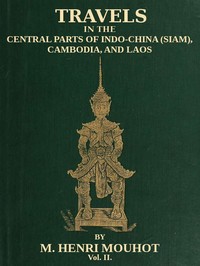
Travels in the Central Parts of Indo-China (Siam), Cambodia, and Laos (Vol.…
This book is the published journal of Henri Mouhot, a French naturalist and explorer, from his travels between 1858 and 1861. He wasn't funded by a grand institution but was driven by his own curiosity. The 'plot' is his journey: up the rivers, through dense and disease-ridden jungles, and into the royal courts and remote villages of Siam, Cambodia, and Laos. He details everything—the stunning wildlife, the challenging climate, the fascinating cultures he encounters, and the kindness (and sometimes wariness) of the people he meets. The narrative builds slowly, filled with observations about insects, birds, and the daily struggle of travel, until it reaches its stunning climax: his arrival at the temple complex of Angkor.
The Story
Mouhot's story is one of gradual, arduous discovery. He writes about bargaining for boats, suffering from fevers, and sketching everything he sees. The central drama unfolds when, deep in the Cambodian jungle, he is led to the ruins of Angkor Thom and Angkor Wat. His descriptions are filled with genuine wonder. He tries to measure the scale, sketches the intricate carvings, and openly wrestles with the same question we have today: How was this built, and why was it abandoned? The book ends not with a neat conclusion, but with Mouhot's journey continuing into Laos, where he would ultimately die of malaria. His journals were sent back to Europe and caused a sensation.
Why You Should Read It
You should read this because it’s the opposite of a dry history text. This is the moment of discovery, told in real time. Mouhot’s voice is clear—he’s amazed, exhausted, curious, and sometimes frustrated. You feel the humidity and the mosquitoes. His account isn't politically correct by our standards, but it's honest for its time, giving you a direct window into a 19th-century explorer's mind. The power comes from seeing a world wonder through the eyes of someone seeing it for the first time, with no postcards or guidebooks to shape his expectations. It makes Angkor feel mysterious and overwhelming all over again.
Final Verdict
This is perfect for armchair explorers, history lovers who want a primary source, and anyone planning a trip to Cambodia or Thailand who wants to understand the 'first look.' It’s not a fast-paced thriller; it’s a slow, immersive travelogue. If you enjoy the gritty, personal diaries of explorers like Livingstone or Stanley, but want a story focused on art and lost civilization rather than geography, Mouhot’s travels will absolutely captivate you. Just be prepared to feel a strong urge to go see it for yourself.
Karen Walker
3 weeks agoGreat read!
Lucas Jones
4 months agoLoved it.




Deborah Thomas
1 year agoBased on the summary, I decided to read it and the atmosphere created is totally immersive. I will read more from this author.