
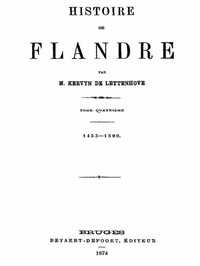
Histoire de Flandre (T. 4/4) by Kervyn de Lettenhove
Kervyn de Lettenhove's fourth and final volume picks up the story of Flanders at its most turbulent hour. We're in the thick of the Eighty Years' War, a brutal conflict where the Protestant northern provinces of the Low Countries are fighting for independence from Catholic Spain. This isn't a simple war story. It's a complex web of shifting loyalties, where local nobles, city councils, and foreign powers all have their own agendas.
The Story
The book follows the final, painful stages of the Dutch Revolt. It chronicles the military campaigns of figures like the Prince of Parma, a brilliant Spanish commander, and the relentless resistance of the Dutch. But the real drama is in the political collapse. You see the southern provinces—what will become Belgium—caught in the middle, devastated by war and ultimately remaining under Spanish control. The narrative leads to the decisive split: the birth of the independent Dutch Republic in the north and the Spanish Netherlands in the south. It's the story of a single cultural region being permanently divided by faith, politics, and war.
Why You Should Read It
What makes this history so gripping is the author's passion. Kervyn de Lettenhove, a 19th-century Belgian scholar, writes with a national pride that's palpable. He isn't a detached observer; he's piecing together the origin story of his own country. This gives the book a compelling energy. You get a real sense of the human cost—the famine during the Siege of Antwerp, the terror of Spanish troops, the impossible choices faced by local leaders. He turns historical figures into characters facing agonizing decisions, which makes the geopolitical stakes feel immediate and personal.
Final Verdict
This is not a casual beach read. It's a rich, detailed, and sometimes dense conclusion to a monumental historical work. It's perfect for history buffs who already have a basic timeline of European history and want to dive deep into the gritty reality of state formation. It's also fantastic for anyone interested in the roots of modern European borders and identities. If you enjoy history that focuses on the 'how' and 'why' rather than just the 'when,' and you don't mind a scholarly (yet passionate) tone, this final volume is a profoundly satisfying and insightful read.
This text is dedicated to the public domain. Use this text in your own projects freely.
Oliver Rodriguez
1 year agoLoved it.
Patricia Hill
10 months agoHonestly, it creates a vivid world that you simply do not want to leave. Exactly what I needed.



Joseph Davis
7 months agoIf you enjoy this genre, the author's voice is distinct and makes complex topics easy to digest. Thanks for sharing this review.